The Mind Elsewhere, the Face Alive: What Neuroscience Reveals About Your Most Authentic Portrait
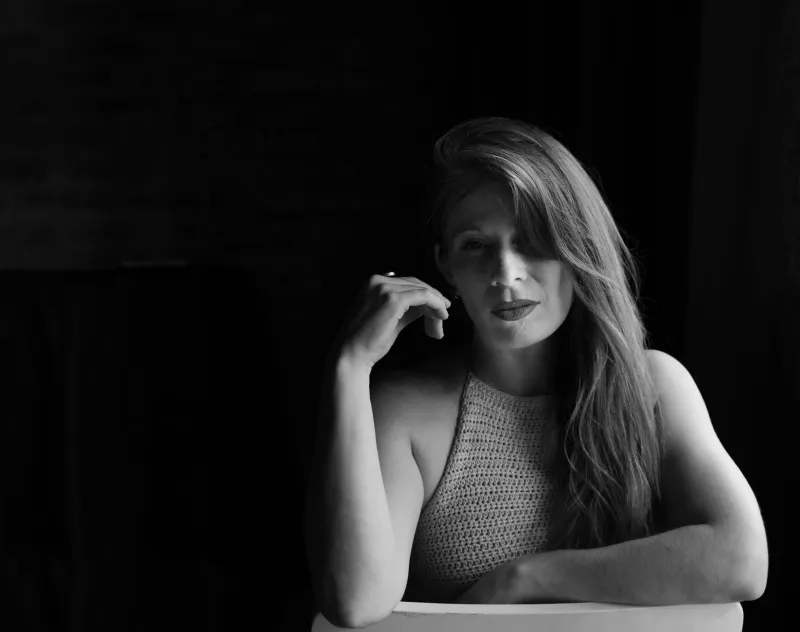
There is a particular quality of light that seems to inhabit certain portraits—a quality that has nothing to do with the studio's fixtures or the photographer's reflectors. It lives, instead, in the subject's eyes. It arrives unannounced, lingers for a fraction of a second, and disappears the moment the person becomes aware of it. Photographers who have spent careers chasing that quality will tell you the same thing: it surfaces when the subject has forgotten, entirely, that they are being photographed.
This is not merely anecdotal wisdom. It is, increasingly, a matter of science.
The Neuroscience of the Unguarded Face
When a person becomes conscious of being observed—particularly in a high-stakes context like a professional portrait session—the brain's prefrontal cortex activates a suite of self-regulatory behaviors. Microexpressions are suppressed. Muscle tension increases around the jaw, the forehead, and the orbicularis oculi, the muscle ring surrounding the eye. The result is what researchers in social neuroscience sometimes call display management: the face shifts from an organ of genuine expression into a performance interface.
This is entirely involuntary. The brain does not distinguish between a job interview and a portrait session; it registers social scrutiny and responds accordingly. The muscles of the face obey ancient, pre-rational instructions to present a socially acceptable version of the self.
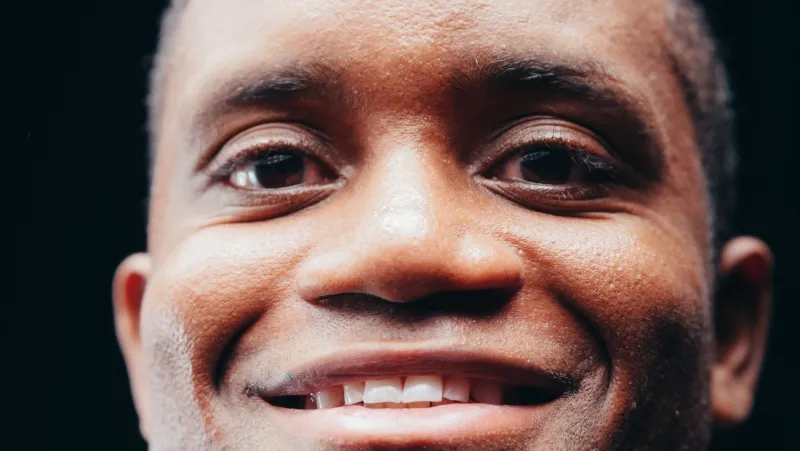
Conversely, when attentional resources are redirected elsewhere—toward a memory, a complex question, a sound in the room, or a task requiring mild concentration—the prefrontal cortex relaxes its supervisory grip. The face reverts to what psychologists call default expressive state: the authentic baseline from which genuine emotion emerges. It is in this state that portrait photographers find their most valuable material.
Stillness Is Not Blankness
One of the most persistent misunderstandings about portraiture—particularly among clients preparing for their first professional session—is the conflation of stillness with blankness. A blank face is one from which expression has been evacuated: muscles flattened, eyes unfocused, the social mask held in neutral. It is the face of someone who has been told to "relax" without being given anywhere for their attention to go.
Stillness, by contrast, is animated from within. It is the face of someone absorbed in thought, tracking a distant idea, or arriving at a quiet realization. The muscles are not tense, but neither are they inert. There is what portrait directors sometimes describe as interior weather—a visible quality of cognitive or emotional activity that registers on the face without announcing itself through overt expression.
The difference is immediately legible to viewers, even those with no training in visual analysis. Multiple studies in social perception have demonstrated that observers consistently rate faces displaying genuine contemplative engagement as more intelligent, more trustworthy, and more compelling than faces displaying posed neutrality. The eye detects authenticity through channels that bypass conscious analysis entirely.
How Creative Directors Orchestrate the In-Between
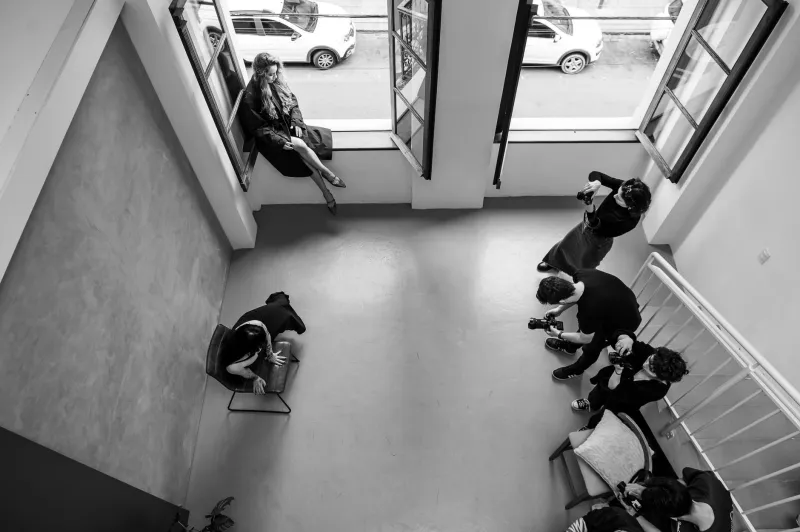
At Portraits & Co., the architecture of a session is designed with this understanding at its foundation. The most productive moments rarely occur at the center of a shoot; they occur at its edges—during the interval before the first frame, in the conversational pause between setups, in the moment after a subject has been asked a question they are genuinely considering.
Experienced portrait photographers develop an extensive repertoire of techniques for redirecting attention without disrupting presence. Some ask questions designed to activate autobiographical memory: not "What do you do for work?" but "Tell me about the place where you did your best thinking this year." The specificity of the prompt draws the subject inward. The face follows.
Others introduce subtle environmental stimuli—a piece of music chosen to evoke a particular emotional register, or a shift in the quality of ambient sound—that occupies a portion of the subject's awareness without demanding their full attention. The camera, in these moments, becomes peripheral. The subject's consciousness is elsewhere. The portrait, paradoxically, becomes most fully themselves.
Styling and wardrobe choices also contribute to this dynamic. When a subject is dressed in something that feels genuinely congruent with their identity rather than performatively correct, the cognitive load of self-presentation decreases. They stop monitoring themselves. The face softens into accuracy.
Understanding Your Own Attention Span
For individuals who engage regularly with portrait photography—whether for personal branding, editorial work, or professional headshots—developing self-knowledge about one's own attentional patterns is a practical and underutilized tool.
Some people enter their most authentic expressive state through verbal engagement: give them an idea to articulate and their face becomes vivid. Others arrive there through physical movement—a brief walk before a session, or a setup that permits some degree of kinetic activity. Still others require silence and minimal stimulus, a few moments of genuine quiet before the session begins.
The professionals who show up most effectively in front of a camera are rarely the most conventionally photogenic. They are, more often, the most self-aware. They understand what kind of environment produces their best presence, and they communicate that understanding to the creative team before the session begins.
This is not vanity. It is image literacy—the capacity to understand how your own psychology intersects with the mechanics of visual capture. It is, in many respects, the most sophisticated form of personal branding: not managing your image, but understanding the conditions under which your image manages itself.
The Portrait That Precedes the Pose
There is a moment in nearly every well-run portrait session that experienced photographers recognize immediately. It occurs before the formal work begins—sometimes while a subject is still removing a coat, or finishing a sentence, or looking toward a window with their mind apparently elsewhere. The light is right. The face is open. The camera, if it is ready, captures something that the rest of the session may spend hours attempting to recreate.
This is not luck. It is the natural result of a mind that has not yet assumed the burden of being seen. The self-consciousness that will arrive with the first deliberate pose has not yet descended. The subject is, for one unguarded interval, simply present.
That presence—fleeting, unrepeatable, and unmistakably real—is the thing that a portrait, at its finest, is built to hold. The science explains the mechanism. The artistry lies in knowing when to press the shutter.
At Portraits & Co., we design every engagement around the pursuit of that interval. Because the image that endures is never the one you performed. It is the one that arrived when you had, for a single luminous moment, forgotten to perform at all.