The Art of Surrender: What Happens When You Stop Directing Your Own Portrait
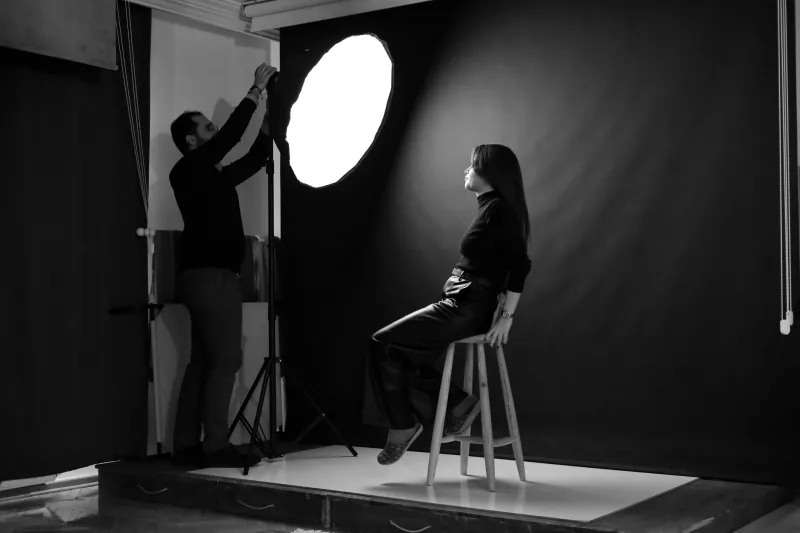
There is a particular kind of tension that visits nearly every portrait session. It arrives quietly—in the way a subject adjusts their chin without being asked, in the subtle repositioning of hands, in the practiced smile that appears the moment a camera is raised. It is the tension of someone who has decided, before a single frame is captured, exactly how they wish to be seen.
This impulse is entirely human. We have spent our lives curating impressions, and the portrait session represents a high-stakes moment in that ongoing project. Yet the paradox at the heart of professional portraiture is this: the more deliberately you attempt to control the outcome, the further the result drifts from the image that would have served you best.
Why Control Undermines the Very Image You Want
The face is a remarkably honest instrument. It communicates far more than its owner typically intends, and it is especially candid in the presence of effort. When a subject is actively managing their expression—calculating angles, rehearsing poses absorbed from years of social media self-documentation—the camera registers not confidence or warmth, but the labor of performance.
Portrait photographers, trained to read the subtle architecture of human expression, recognize this dynamic immediately. The slight tension around the jaw, the eyes that are present but not quite alive, the posture that is technically correct yet somehow inert—these are the hallmarks of a subject who is working very hard to appear effortless. The result is an image that is competent but rarely compelling.
Contrast this with the moment a subject genuinely laughs at something unexpected, or turns their head in response to a sound from across the room, or allows a pause to settle over them without rushing to fill it with a practiced expression. In those unguarded intervals, the face reveals a dimensionality that no amount of careful posing can manufacture.
The Psychology of Creative Vulnerability
Surrendering control in a portrait session is not a passive act. It requires a specific form of courage—the willingness to trust another person's vision of you, which necessarily means tolerating the possibility that vision will differ from your own.
Psychologists who study creative collaboration describe this dynamic as productive vulnerability: the state in which an individual sets aside their defensive self-presentation in order to participate more fully in a shared process. In therapeutic contexts, it is understood as a prerequisite for genuine connection. In portrait photography, it functions as the threshold between documentation and revelation.
Clients who have undergone this shift—often reluctantly, and rarely by design—frequently describe the experience in similar terms. A marketing director based in Chicago once recalled arriving at her session with a detailed brief: specific angles she believed were flattering, a particular expression she had practiced, even reference images pulled from other executives' LinkedIn profiles. Forty minutes into the shoot, her photographer gently set the brief aside and asked her simply to describe the project she was most proud of. She spoke for several minutes without thinking about the camera at all. The images from those minutes became the centerpiece of her professional rebrand.
Her story is not unusual. It is, in fact, the rule rather than the exception.
What the Photographer Sees That You Cannot
There is an inherent limitation in attempting to direct your own portrait: you cannot simultaneously be the subject and the observer. The self-image you carry—assembled over decades from mirrors, photographs, and the reflected assessments of others—is not the same image a skilled portrait photographer encounters when you walk into the studio.
A professional photographer brings a trained, external eye that is unburdened by your history. They do not see the photograph you hated from your cousin's wedding in 2019, or the headshot that prompted an unkind comment from a former colleague. They see the person in front of them, in the available light, in this particular moment—and they are equipped to identify the qualities that photograph most powerfully, many of which you may have long dismissed or simply never considered.
This is the core value of the creative partnership that portrait work represents. It is not a service transaction in which you specify an output and a technician delivers it. It is a collaborative process in which your role is to show up fully present, and your photographer's role is to recognize and capture what that presence contains.
Practical Frameworks for Releasing the Reins
For many clients, the intellectual understanding that surrender produces better results does not automatically translate into the ability to surrender. The impulse to manage one's own image is deeply conditioned, and it does not dissolve simply because one has decided it should.
Several approaches have proven effective in bridging this gap.
Establish trust before the session begins. A thorough consultation—one in which your photographer asks substantive questions about your professional goals, your audience, and the impression you genuinely wish to create—builds the relational foundation that makes creative delegation possible. When you understand that your photographer is working in service of your actual objectives, releasing tactical control becomes considerably less threatening.
Arrive with intention, not instruction. There is a meaningful distinction between communicating what you hope the images will accomplish and prescribing exactly how they should be produced. The former gives your photographer the context they need to make informed creative decisions. The latter constrains the very expertise you are paying for.
Agree to a period of genuine experimentation. Many photographers recommend dedicating the first portion of a session to exploratory work—frames neither party is expected to love, taken specifically to move through the self-conscious early phase of any shoot. Knowing that the first twenty minutes carry no pressure often accelerates the arrival of something genuine.
Resist the impulse to review images mid-session. The habit of checking the camera's display after each sequence pulls subjects out of the present moment and into the role of critic—a role that reliably reinvokes the very self-consciousness the session is working to dissolve.
The Portrait That Surprises You Is Often the One That Serves You
The images that clients initially resist—the ones that feel unfamiliar, that don't match the self-concept they arrived with—are frequently the images that generate the most meaningful responses from their professional networks. A portrait that surprises you is often one that reveals something others have always seen but you have not yet learned to recognize in yourself.
This is the deeper promise of the collaborative portrait process: not merely a flattering image, but an accurate one. Not the face you have decided to present, but the face that, when given space to simply exist in front of a skilled lens, tells a more interesting and more honest story than any carefully managed performance could.
At Portraits & Co., we have observed this transformation across countless sessions and industries. The subjects who leave most satisfied are rarely those who arrived most prepared. They are the ones who arrived most willing—willing to be seen on terms they did not entirely dictate, and willing to be surprised by what the camera found.