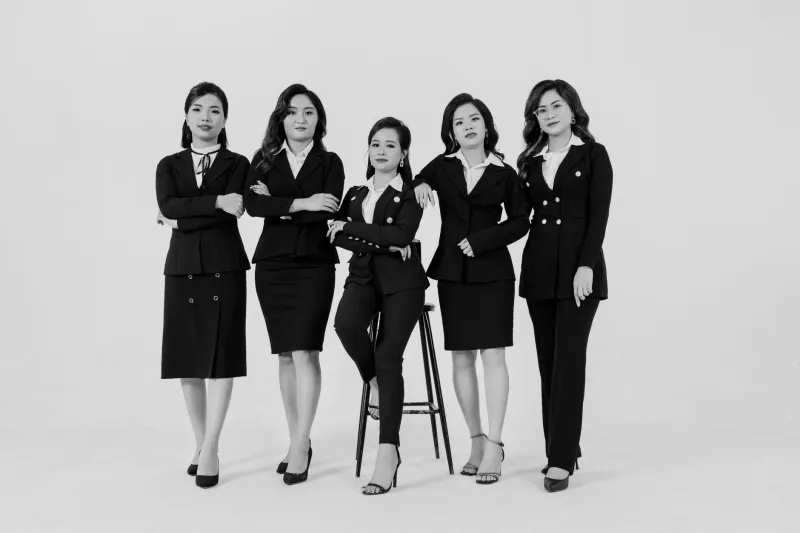
The Power of the Unpolished: When Strategic Vulnerability Becomes Your Greatest Visual Asset

There is a particular kind of portrait that stops the scroll. Not because the lighting is flawless or the subject's jaw is perfectly angled toward the lens. It stops the scroll because it feels unmistakably, uncomfortably true.
In a professional landscape where image curation has become a near-universal practice, audiences have developed a finely tuned instinct for the manufactured. They recognize the softened skin, the strategically placed shadow, the smile calibrated to project warmth without revealing too much. And increasingly, they are moving past it—toward the portrait that dares to show something real.
This is the authenticity paradox: the image you are most tempted to reject, the one that feels too raw or too exposed, may be the one that defines your brand for years to come.
The Science Behind Imperfection's Appeal
Human beings are neurologically wired to trust faces that display vulnerability. Research in social psychology consistently demonstrates that the perception of effort and imperfection activates empathy circuits in ways that polished presentation simply does not. When we see a portrait that has not been scrubbed clean of its humanity, we unconsciously read it as evidence of authenticity—and authenticity, in the current cultural moment, is among the most commercially valuable qualities a professional can possess.
This is not merely a philosophical observation. It is a measurable phenomenon that practitioners of image science are beginning to quantify. At Portraits & Co., we have observed this dynamic across client engagements: the executive who agreed to a portrait taken mid-conversation rather than posed at attention, the founder who kept the laugh lines rather than smoothing them in post-production, the creator who chose an unconventional crop that revealed a candid, slightly off-balance moment. In each case, the response from their audiences was not disappointment at the lack of polish. It was recognition.
Case Studies in Courageous Portraiture
Consider the trajectory of entrepreneurs who have made deliberate choices to move away from the traditional LinkedIn-ready headshot. Brené Brown, whose entire professional identity is built on the language of vulnerability, has long favored portraits that lean into expressiveness over composure. The result is an image ecosystem that mirrors her message—and that coherence is precisely what makes her brand feel credible rather than constructed.
In the startup world, founders who document their building process through candid portraiture—exhausted but energized, surrounded by whiteboards and coffee cups rather than staged boardrooms—have consistently reported stronger community engagement than their counterparts who maintain a more curated visual distance. The portrait becomes evidence of lived experience rather than projected aspiration.
This pattern repeats across industries. Musicians, athletes, and public intellectuals who have allowed unflattering or emotionally complex portraits to circulate have frequently found that those images become the ones most widely shared, most deeply remembered, and most closely associated with their authentic identity.
Defining "Strategic" Imperfection
It is critical to distinguish between imperfection that serves your brand and imperfection that simply undermines it. The goal is never randomness or carelessness. It is intentionality that looks unguarded.
Strategic imperfection operates along several axes:
Emotional honesty over emotional performance. A genuine laugh, even if it produces an unflattering crinkle, reads as more trustworthy than a curated smile. The camera and the audience both know the difference.
Unconventional framing that signals confidence. Choosing a portrait where you are not centered, or where the background tells a story about your actual environment, communicates that you are secure enough in your identity not to require the safety of convention.
Visible texture and specificity. The details that make you particular—a scar, an asymmetry, an expressive forehead—are the details that make you memorable. Homogenizing these features in post-production trades distinction for a kind of visual anonymity.
Raw context over sterile backdrop. A portrait taken in your actual workspace, even if that workspace is imperfect, grounds your image in reality. It tells a story that a seamless gray studio backdrop simply cannot.
A Framework for Deciding When to Break the Rules
Not every professional context calls for the same degree of visual vulnerability. The decision to embrace imperfection should be calibrated against three questions:
1. Does the imperfection reinforce or contradict your core message? A financial advisor whose brand is built on precision and reliability may find that a highly candid portrait creates cognitive dissonance rather than connection. Conversely, a therapist, a creative director, or a wellness founder may find that the same portrait style is essential to establishing trust.
2. Who is your primary audience, and what do they value? Younger, digitally native audiences have a particularly high sensitivity to performed perfection. They have grown up in an era of behind-the-scenes content and unfiltered storytelling, and they respond accordingly. More traditional professional audiences may still expect—and reward—a higher degree of formal presentation.
3. Is this the right moment in your brand's lifecycle? A portrait that leans into vulnerability can be extraordinarily effective as a pivot point—when you are transitioning roles, launching something new, or deliberately signaling growth and change. It is less effective as a default posture maintained indefinitely without evolution.
The Portrait as Permission
There is a deeper reason why the unpolished portrait has such power in the current moment. It functions as a form of permission—permission for your audience to be imperfect too, to have texture, to exist in the space between aspiration and reality.
When a professional chooses an image that does not pretend, they are communicating something beyond their own identity. They are signaling a set of values: transparency over performance, substance over surface, connection over admiration.
At Portraits & Co., we work with clients to identify the precise point at which their image becomes most theirs—not the version that has been optimized into a kind of pleasant anonymity, but the version that carries the specific weight of their experience and perspective. That portrait is rarely the safest one in the folder. It is almost always the most powerful.
The paradox resolves itself, in the end, quite simply: the portrait you are afraid to use is often the one your audience has been waiting to see.