What Stands Behind You: The Strategic Psychology of Portrait Backgrounds
Most professionals spend considerable time preparing the foreground of their portrait—selecting clothing, refining grooming, practicing an expression that strikes the right balance between approachable and authoritative. Comparatively little thought goes to what appears behind them. This is a significant oversight, and one that portrait psychology research makes increasingly difficult to justify.
The background of a professional image is not neutral. It never has been. Every element visible behind the subject—whether a seamless studio wall, a curated bookshelf, an open landscape, or a branded office environment—functions as a secondary communication channel, transmitting information about status, personality, and professional context before the viewer has consciously registered a single detail. Understanding how that channel works, and learning to use it deliberately, is one of the more underappreciated skills in personal brand management.
The Viewer's Brain Does Not Separate Figure from Ground
Gestalt psychology established decades ago that human perception treats figure and ground as a unified composition, not as independent elements. When someone views your portrait, their brain processes the relationship between you and your background simultaneously, drawing inferences from the whole rather than evaluating each component in isolation.
This means that a technically excellent photograph of a compelling subject can be quietly undermined by an incoherent or misaligned background. Conversely, a thoughtfully chosen setting can elevate an otherwise straightforward image into something that feels authoritative, distinctive, and entirely intentional.
The practical implication is direct: background selection is not a logistical decision. It is a strategic one.
The Minimalist Studio: Power Through Restraint
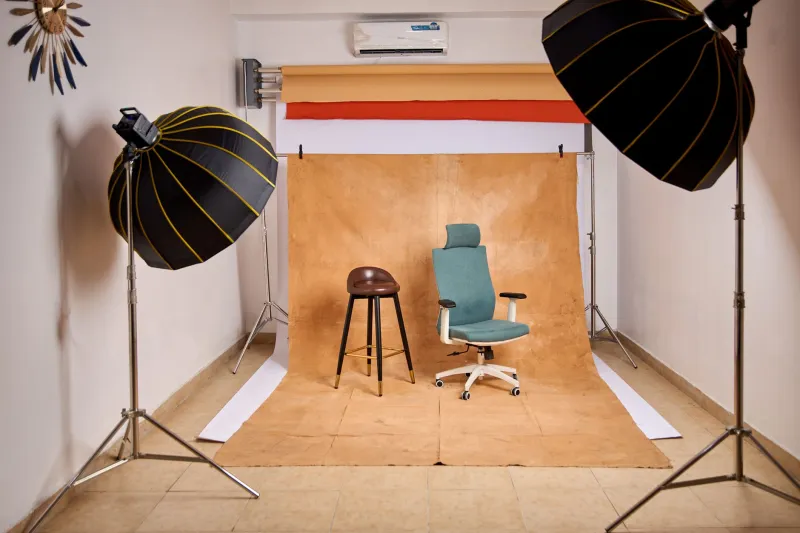
The seamless backdrop—white, gray, or black—remains the most widely used background in professional portrait photography, and for good reason. Its psychological effect is well-documented. By eliminating environmental context, the minimalist studio forces all attention onto the subject. There is no setting to interpret, no room to read, no organizational culture to infer. There is only the person.
This concentration of attention communicates a particular kind of confidence. It says, implicitly, that the subject requires no supporting context—that their presence alone is sufficient. For executives, public speakers, and professionals whose personal authority is the primary product they offer, this is an effective and honest signal.
However, the minimalist studio carries its own risks. Without environmental cues, viewers rely entirely on expression, posture, wardrobe, and lighting to construct their interpretation of the subject. There is no ambient warmth, no contextual texture, no sense of place. For professionals whose brand depends on relatability, creativity, or community connection, a completely stripped environment can read as cold or inaccessible—precise when warmth was the intention.
The Branded Environment: Context as Credential
For business owners, creative directors, and professionals whose work is inseparable from a physical space—restaurateurs, architects, studio artists, retail entrepreneurs—a branded environment offers a background strategy that minimalist settings cannot replicate: it makes the context itself a credential.
When a portrait is made inside a space that belongs to the subject, every visible element contributes to the narrative. The quality of the materials, the organization of the workspace, the aesthetic coherence of the environment—all of it speaks to professional standards and creative sensibility. The background becomes a portfolio.
The execution demands care. A branded environment that reads as cluttered, poorly lit, or visually inconsistent with the subject's desired positioning will work against the portrait rather than for it. The goal is not to document a space but to curate it—to select the angle, depth of field, and ambient details that tell the right story about who operates within it.
The Home Office: Intimacy and Its Complications
The widespread normalization of remote work has made the home office background one of the most commonly seen—and most commonly mishandled—settings in professional portraiture. The appeal is obvious: it signals authenticity, accessibility, and the modern fluidity between professional and personal life that many audiences find relatable.
The risk is equally obvious. A home office background that has not been thoughtfully prepared communicates disorganization, informality, or an indifference to professional presentation that can undercut even a strong foreground subject. Bookshelves are particularly instructive here. Research in impression formation has consistently found that viewers draw rapid, detailed inferences from the books, objects, and organizational systems visible in a subject's background—often more than they consciously realize.
For professionals who choose a home office setting, the standard of curation must be high. Every visible element should be intentional. The background should feel lived-in but considered, personal but professional—a balance that is achievable with preparation and the guidance of an experienced photographer.
Outdoor and Architectural Settings: Context Without Confinement
Natural and architectural backgrounds occupy a distinct psychological register. They communicate openness, dynamism, and a kind of expansive confidence that interior settings rarely achieve. For professionals in fields associated with innovation, exploration, or creative thinking—consultants, designers, educators, entrepreneurs—an outdoor or architectural setting can powerfully reinforce those associations.
The selection of a specific outdoor environment carries its own layered meaning. An urban architectural setting signals engagement with commerce and contemporary culture. A natural landscape communicates grounding, perspective, and a certain unhurried quality that can be enormously appealing in high-pressure professional contexts. A coastal or open-sky setting evokes possibility and forward orientation.
The practical challenge of outdoor and architectural portraiture is control. Natural light is variable, environmental elements are unpredictable, and the logistical complexity of location shoots is significantly greater than studio work. These challenges are manageable with professional support, but they require planning that many clients underestimate.
A Framework for Background Selection
Choosing the right background for a professional portrait begins with three questions, each of which should be answered before any session is scheduled.
First: Who is your primary audience, and what do they need to feel about you? Audiences that prioritize authority and expertise respond differently to background cues than audiences that prioritize relatability and creative energy. Your background should be calibrated to the specific perceptual needs of the people you most need to reach.
Second: What aspect of your professional identity is currently underrepresented? If your existing portrait communicates competence but not warmth, a more contextual background may help close that gap. If it communicates accessibility but not authority, a more restrained setting may do the same.
Third: What is the background actually saying, independent of your intentions? This question is best answered with outside perspective. At Portraits & Co., we conduct environmental assessments before location sessions specifically to identify the gap between what a client believes their chosen setting communicates and what it actually transmits to an uninvested viewer.
The Background Is Never Neutral
Every setting carries meaning. Every background makes an argument. The question is not whether your portrait background communicates something—it always does—but whether what it communicates serves the professional narrative you are working to build.
The most effective portraits are those in which every visible element, from the foreground subject to the furthest depth of field, is working in the same direction. Achieving that coherence requires treating the background not as a backdrop but as a collaborator—a visual partner in the construction of an image that is, in the fullest sense of the phrase, completely intentional.